
Music royalty payments to artists involve more than initiating a bank transfer. As a music company, you’re managing payee banking details, collecting tax information for compliance, reconciling what was paid against what was owed, handling returned payments, and doing it all on a deadline — every period. How music companies manage that process varies significantly, and the method of payment has a direct impact on how much time, risk, and operational overhead gets added to your royalty cycles.
There are three primary ways music companies pay artist royalties: directly through their bank, through a third-party payment platform, or through integrated payments built into their royalty software. This guide breaks them down.
Table of Contents
Royalty payments directly through your bank
The most common starting point for small music labels and music businesses is paying artists directly through their bank — ACH transfers, wires, or in some cases, checks. No additional platform required.
In practice, this approach works until it doesn’t. For a label with only a handful of artists, paying out on a semi-annual cadence, direct bank payments are manageable. For anyone with a growing roster, international payees, or more frequent payouts, the friction accumulates fast.
What this looks like operationally:
- Your royalty system is just a calculator and tells you what each artist is owed.
- Export or manually reference those balances.
- Verify banking details for each payee — hopefully organized somewhere that’s accessible and secure.
- Initiate each payment individually through your bank’s portal.
- Record what was sent in your royalty system.
- Follow up on anything that bounced or failed.
For domestic music royalty payments this is tedious. For international payments, you’re also navigating currency conversion, SWIFT fees, and varying compliance requirements by country.
The bigger the roster, the more this process compounds. A label paying 100 payees manually each quarter is spending significant hours on work that requires more human time than human judgement.
The core limitations:
- Reconciliation is manual. There’s no connection between payment execution and royalty records.
- Banking details are managed separately, creating validation errors and security risks.
- International payments require additional tools or banking relationships.
- There’s no payee visibility into payment status without direct communication.
- Tax information is typically collected separately, not integrated with payee payment records.
- Scales poorly as catalog and roster grow.
Royalty payments through third-party platforms
The preferred option for many music companies is adding a dedicated payment platform — Tipalti, Wise, PayPal, or similar. These tools solve some of the problems with direct bank payments: they handle international transfers more efficiently, store payee banking details in one place, and provide a more structured process for initiating and tracking payments.
The problem is that a third-party payment platform and a royalty platform are two separate systems that still don’t talk to each other. This means data has to move between them and be reconciled manually.
What this looks like operationally:
- You process music royalties in your royalty system and generate finalized balances.
- You then export those balances (usually as a spreadsheet) and import them into your payment platform.
- You initiate payments to your payees.
- You add payment details into your royalty system to record what was actually paid, either by importing an excel template or manually entering the data.
Every handoff in that chain is a point of failure. A formatting mismatch in the export. A payee name that doesn’t match exactly. A balance that was updated after the export but before the upload. An executed payment that didn’t get recorded in the royalty system, causing the next period’s calculation to be off.
What this cost looks like in practice: Before Tone, one record label managed music royalty accounting and music royalty payments separately. After calculations were finalized, balances were exported and each payment was manually created — for hundreds of artists. The entire process took a full weekend for their royalty admin.
The core limitations:
- Reconciliation is manual, there’s no connection between payment execution and royalty records.
- Payee records must be maintained in two places simultaneously.
- Tax information is typically collected separately, not integrated with payee payment records.
- Scales poorly as catalog and roster grow.
Integrated music royalty payments in your royalty platform
Integrated payments means your royalty calculations and your payment execution live in the same system. Once royalties are processed and statements are finalized, payments are initiated directly from the same platform — no export, no import, no manual reconciliation.
Among the major music royalty platforms in the market today, Tone is one of the only systems with integrated payment functionality. For music companies evaluating royalty software, the presence or absence of integrated payments is a meaningful operational decision — not a minor feature difference.
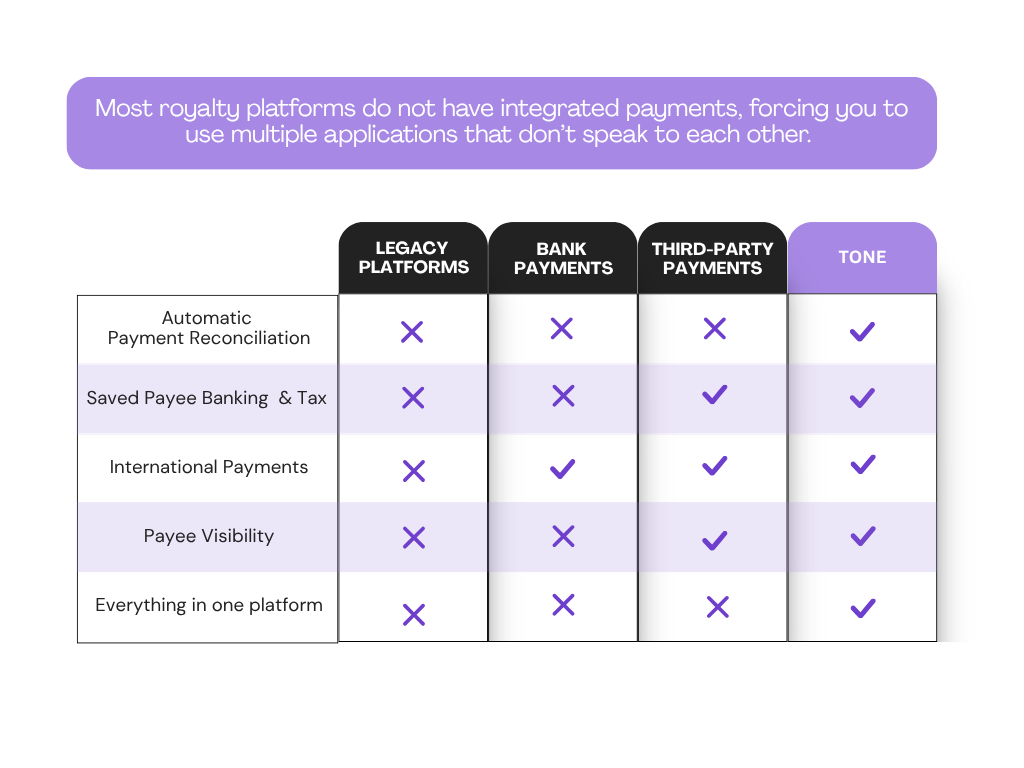
What music royalty payment integration changes operationally:
- Payee banking and tax details are collected from the payee during onboarding and stored in Tone. (When a payee updates their banking details, it updates in one place — no tracking or management required from the label.)
- Once royalties are processed and statements are finalized, payments are matched and initiated directly within the platform.
- Payment transactions are automatically recorded against the royalty period that generated them — the next period’s calculation starts from accurate data.
When payments are generated within the same platform as the royalty calculation, the reconciliation problem largely disappears. The payment record lives in the the same system as the royalty record, tied to the same period, the same statement, and the same payee. This operational difference compounds over time. A label processing quarterly royalties for 200 payees isn’t just saving a few hours on payment day — they’re eliminating an entire category of reconciliation work, error correction, and cross-system coordination from every cycle.
What disconnected music royalty payments actually cost
The operational overhead of managing payments outside your royalty system is easy to underestimate when you’re doing it manually — it just becomes part of the process. The real cost shows up in three places:
Time: Every export, import, manual entry, and reconciliation step is time your team spends on work that doesn’t require judgment — just execution. For a label paying hundreds of payees, this can represent an entire day or more of work per royalty cycle.
Errors: Manual data transfer between systems is where payment mistakes happen. A balance that was updated after the export. A payee record that doesn’t match. A payment that executed but didn’t get recorded. These errors don’t always surface immediately — sometimes they appear in the next period’s calculation, in a payee inquiry, or in an audit.
Audit risk: The most significant operational risk of disconnected payment workflows is when payment transactions get recorded in a royalty system without being tied to payments that actually occurred.
What this cost looks like in practice: One royalty admin described working with a system that had auto-payments enabled — meaning every time a contract’s balance was calculated, the system automatically recorded it as paid, whether or not a payment had actually been issued. A label had been running this way for years without realizing it. Contracts that should have been accruing payable balances appeared cleared each period. Statements were incorrect. The actual payment history didn’t match the records. Untangling it was a significant project.
Tone’s approach is different: payment transactions are only auto-generated when a payment is actually issued through Tone. The ledger reflects money that moved — not money that system calculated an artist was owed.
How Tone's integrated payments work
Tone’s payments are built on Airwallex, a global payments and financial operations platform. The Tone Wallet acts as a secure holding account for labels — funded via ACH or wire, then used to issue payouts directly to payees worldwide.
The workflow from royalty period to payment looks like this:
Payee onboarding: Payees submit their banking and tax information directly through their Tone portal during onboarding — something no other royalty platform currently does. Labels don’t collect or store sensitive banking details themselves. Payees can update or change their own banking details at any time. If a payment is returned, the funds will be automatically returned to the label’s Airwallex wallet and the label will receive an email notification of the payment failure.
Payment selection: Once statements are published, Tone shows exactly which payees are verified and ready for payment. You select the payments you want to issue — all of them, or select ones — and review the total funding amount upfront, inclusive of all applicable fees. No estimating or additional surprise fees.
Funding and payout: Fund your Tone Wallet via ACH or wire for the exact amount shown. Once funds are received, payments can be issued and typically arrive within a few hours to a few days, depending on the destination. Domestic and international payments use the same workflow for all regions.
Automatic reconciliation: Payment transactions are automatically recorded in Tone against the royalty period that generated them. The ledger updates in real time so the next period’s calculation starts from accurate data.
For a deeper look at how the Tone Wallet is set up and how the four-step payment process works inside the platform, see our full guide: Integrated Royalty Payments for Music Labels.
Tone vs. Curve: integrated music royalty payment differences
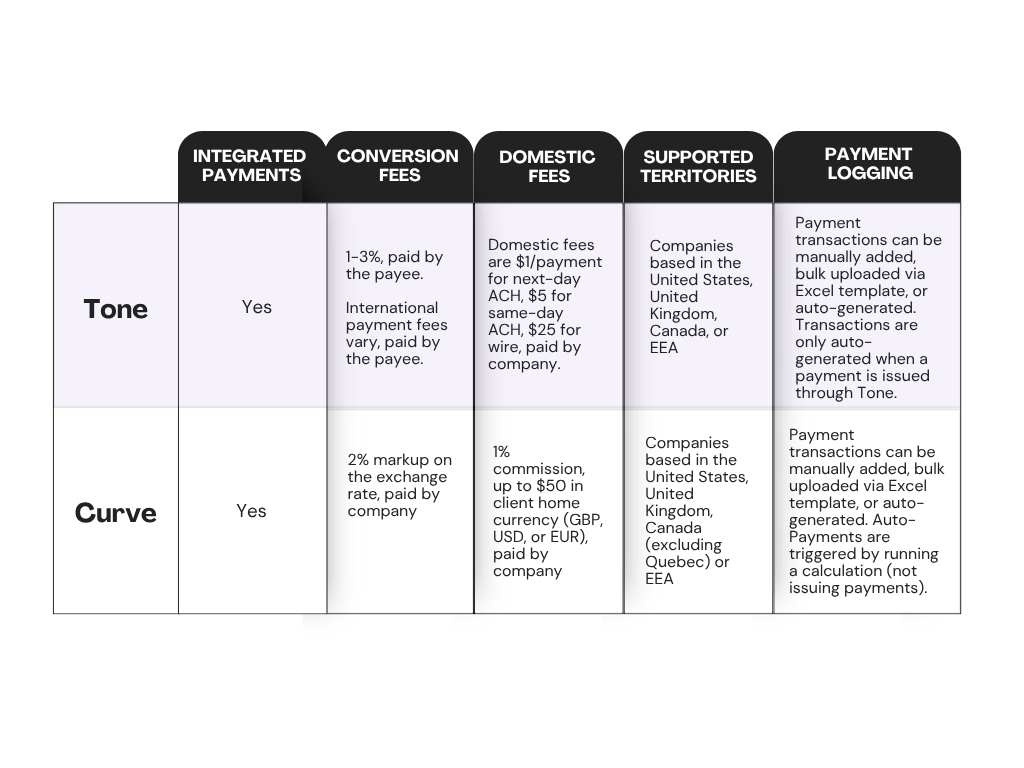
Payment ledger accuracy. In Curve, auto-payment transactions can be triggered when a calculation runs — not when a payment is actually issued. This creates the possibility of a payment being recorded before it’s confirmed as executed. In Tone, auto-generated transactions are only created when a payment is issued through Tone.
Payee banking details. In Curve, if the same artist is associated with multiple payee records, they must re-enter banking details for each one. In Tone, banking and tax information is entered once and applies across all of that payee’s contracts with the label.
Tax collection. Curve does not collect tax forms from payees. Tone collects and verifies tax information as part of payee onboarding — the only royalty platform currently doing so.
Funding transparency. Curve advises clients to add “headroom” when funding their account to account for fees. Tone calculates and displays the exact funding amount required upfront, inclusive of all applicable fees.
Supported territories. Both platforms support companies based in the US, UK, Canada, and EEA. Tone uses Airwallex as its payments partner. Curve uses CurrencyCloud, a Visa subsidiary.
Frequently asked questions
How do music labels pay royalties to artists?
Music labels pay artist royalties through one of three methods: direct bank transfers initiated manually, third-party payment platforms such as Tipalti or Wise, or integrated payments built into their royalty software. Direct bank payments work for small rosters but scale poorly. Third-party platforms add structure but require manual data transfer between systems. Integrated payments — available in Tone and Curve — allow labels to calculate royalties and issue payouts within the same platform, eliminating the reconciliation work that disconnected workflows create.
What royalty software has integrated payments?
Tone is one of the only royalty management platforms that has integrated music royalty payments. Most other royalty platforms do not include integrated payments, requiring labels to manage payouts through a separate bank or payment platform and manually reconcile payment records back into their royalty system.
How long does it take for royalty payments to reach artists?
Royalty payment timing depends on the payment method and destination. Through Tone’s integrated payments, domestic payments typically arrive within a few hours to a few days after the payments are executed. International payments vary by destination. The time from initiating payment to artist receipt is typically shorter with integrated payments than with manual bank or third-party platform workflows, which add coordination steps between systems.
What tax information do music companies need to collect from artists before paying royalties?
Music companies paying royalties typically need to collect W-9 forms from US-based payees and W-8 forms from international payees for tax reporting purposes. Tone collects and verifies required tax information from payees as part of the payee onboarding process — the only royalty platform currently doing so. Other platforms require labels to collect tax information separately and manage their own tax documentation process.
What happens when a royalty payment is returned or fails?
When a royalty payment fails — typically due to incorrect banking details — the label is notified and must obtain updated information from the payee before re-issuing the payment. In Tone, returned payment follow-up is handled by Tone’s team directly, so labels don’t have to chase payees for new routing numbers or IBANs. In other systems, this coordination falls on the label’s royalty or accounting team.
Can music companies pay international royalties in local currency?
Yes, through integrated payment platforms with built-in currency conversion. Tone supports international royalty payments across the US, UK, Canada, and EEA through Airwallex, with currency conversion handled within the same workflow. Payees receive payments in their local currency without the label needing to manage separate currency accounts or banking relationships by region.
Conclusion
The music royalty calculation is only half the job. Getting money to the right people, in the right amount, with an accurate record of what moved is the other half, and its operational burden is often underestimated.
For music companies still managing payments outside their royalty system, the cost is real: time spent on manual transfers, errors introduced at every handoff, and reconciliation work that compounds period after period. Integrated payments eliminate that layer entirely — not by making royalties less complex, but by removing the friction between knowing what’s owed and actually paying it.
Tone is built to be royalty operations infrastructure for the modern music industry. If your current payment workflow involves exports, imports, and manual reconciliation, book a demo to see how integrated payments work inside Tone — and what your payout cycle looks like when it’s all in one place.