
If you run royalties, you know the real work starts long before a royalty calculation ever runs. In reality, every royalty period depends on processing sales statements that arrive in different formats, with varying levels of completeness.
Before you can generate payouts, your data must be:
- Standardized
- Mapped to contract terms
- Validated for accuracy
That’s where the time goes for royalty administrators. Not in the math—but getting the data into a state where you can actually trust the math. And yet, despite how critical this step is, most royalty systems haven’t meaningfully improved how they handle sales file processing.
Why Sales File Processing Breaks in Most Systems
Sales file processing isn’t inherently complex. But in practice, most royalty management platforms solve it poorly. The same problems show up across nearly every royalty workflow, yet most systems still rely on approaches that don’t hold up under real-world conditions.
Every distributor delivers sales files differently
No two sales reports are exactly the same and even small differences create friction.
- Territory codes don’t align with contract terms
- Distributors label channels inconsistently (or inaccurately)
- Date formats and reporting periods vary
- Report terminology doesn’t match the system terms
- Files include multiple tabs that you need to export independently
As a result, each of these requires manual intervention before processing can begin. And that work repeats every report and every period.
Template-based systems don’t scale
Most royalty platforms rely on strict templates to process sales files. These templates are built to be reusable but in practice, they introduce more risk. You create a template, process files, run royalties—and then change that template later. At that point, you lose a clear record of how you actually processed earlier files.
To work around this, teams often:
- Duplicate templates to preserve history
- Rebuild templates for edge cases
- Maintain external documentation just to track changes
What should be a system of record becomes something royalty administrators have to manage manually.
Processing logic is often invisible
Most royalty management systems process sales data behind the scenes without showing how it happens.
That creates risk:
- It’s hard to trace how the system derives a value
- Teams struggle to isolate and fix errors
- You rely on spreadsheets and lookup tables to validate results or identify inconsistencies
When you can’t see how the system handles your data, you can’t trust the output.
What Better Sales File Processing Should Look Like
If sales file processing is the foundation of royalties, then the system handling it needs to do more than accept file uploads.
It should:
- Standardize incoming data
- Validate inconsistencies before they impact payouts
- Show how the system transforms data in real time
- Preserve a clear record of how you process each file
- Reduce repetition without removing oversight
This is the problem Tone set out to solve.
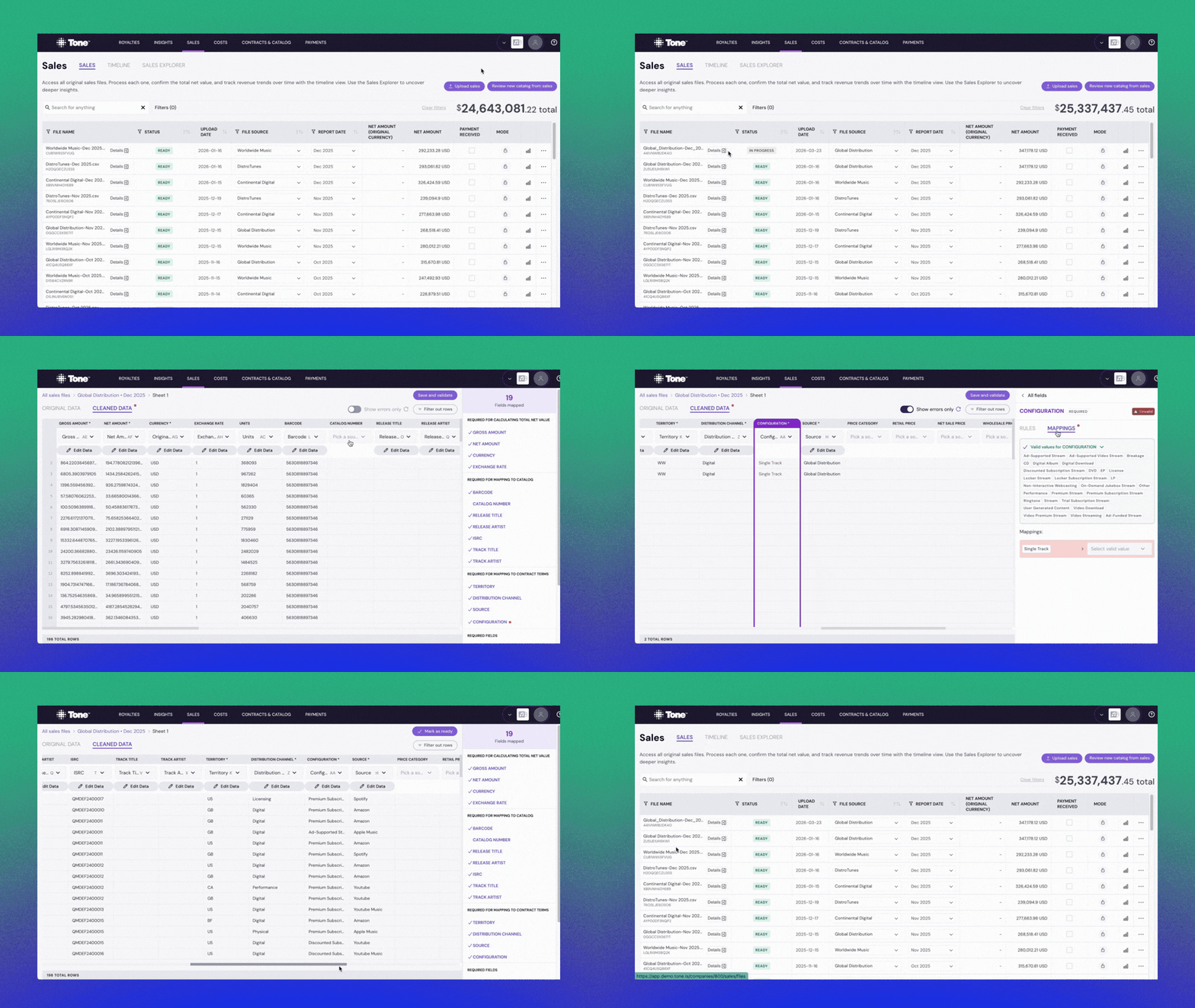
How Tone Rebuilt Sales Processing
Instead of improving templates, we rethought how sales data should be structured, processed, and tracked inside a royalty management system.
The result is a workflow built around standardization, automation, transparency—and control.
When royalties are calculated, Tone shows:
- Which payees are verified (who has submitted required tax and banking information)
- Which balances are ready for payout
1. Standardization and Validation Built In
From the start, Tone standardizes incoming sales data so it aligns with your contract terms from the start.
Importing a sales file from a distributor already in the system? Tone maps and validates territories, distribution channels, and configurations automatically. And flags any missing or inconsistent data immediately
You can:
- Toggle to “Show Errors Only”
- Resolve any errors or invalid values before you run royalties
- Track file status and mark files as “Ready” before you include them in a period
Validation isn’t optional—it’s part of the workflow. This ensures your royalty periods are always based on complete and verified data.
2. A Different Approach to Templates: Rules That Preserve History
Tone doesn’t treat templates as static objects that teams can overwrite. Instead, it treats them as reusable rules and conditions that you can apply across files—without losing your historical context.
That means:
- Any changes you make apply only to the file you’re actively working in
- Every file retains a clear record of how you processed it
- You can still apply the same rules & conditions across multiple files
You get the efficiency of templates without sacrificing transparency.
3. Auto-Matching for Recurring Sales Files
Most distributor reports don’t change significantly from period to period. To reduce repetitive work, Tone uses Auto-Matching to take advantage of that.
When you upload a file from a source you’ve already created, Tone:
- Looks at how you previously processed files from the same source
- Applies the same rules, mappings, and validations
- Tone flags any differences that require review
If the structure matches, your file is ready almost immediately. It’s thoughtful automation that reduces the time spent doing repetitive work.
4. Flexible Rules and Custom Calculations
Sales data isn’t just mapped—it often needs transformation. Tone supports flexible rules so you can handle real-world edge cases directly in the platform.
- Combine fields to create custom values
- Process multi-tab files (and instruct Tone to ignore any tabs you don’t need)
- Convert multicurrency files into your home currency
- Adjust formatting on dates, text fields, and numeric values
- Apply distribution fees and other custom calculations
Instead of manually editing files before upload, you can handle everything within Tone.
5. Safely Uploading and Managing Historic Sales
One of the biggest challenges for royalty teams is working with historic data. For teams working with legacy data, Tone allows you to upload historic sales files without risking double reporting or data conflicts.
You can:
- Upload files to view analytics without including them in payouts
- Block specific files from use in royalty calculations
- Upload adjustment files and prevent original files from being reused
- Maintain a complete, centralized record of your catalog’s performance
This allows Tone to become the source of truth for your royalty data, analytics and payouts.
6. Full Transparency Into Your Data
Most importantly, every step of the process is visible.
You can:
- View the original, unedited distributor file directly in the platform
- Instantly preview the cleaned data after transformations
- See exactly how rules are applied
- Maintain a permanent record of how each file is processed
Nothing is hidden.
Royalty Infrastructure for Modern Music Businesses
As catalogs grow and distribution becomes more complex, royalty workflows will only become more demanding. More platforms. More formats. More edge cases.
Ultimately, sales processing isn’t just an operational step—it impacts how your entire business runs.
When workflows are manual and inconsistent:
- Royalty periods take longer to close
- Errors create downstream disputes
- Teams spend time fixing data instead of analyzing it
When sales processing is structured and reliable:
- Royalties run faster
- Reporting is more consistent
- Teams can scale without increasing operational overhead
As a result, labels and business managers gain better visibility, stronger financial control, and more confidence in every payout.
We built Tone to provide that foundation—starting with the part of the workflow that matters most: how you process your sales data.
Ready to see how Tone’s sales file processing will transform your music business? Book a demo.