
Your royalty catalog management determines the accuracy of your record label’s financials. Catalog metadata dictates if sales and costs are allocated to the correct recording and contract. Even the smallest errors, like a transposed number, a typo in an artists name, or misplaced decimal point, can lead to unmapped revenue, extra cleanup for your royalty admin, and difficult conversations with your artists about delayed income. In worse cases, metadata errors can cause sales and costs to be attributed to the wrong track or release, resulting in inaccurate royalty reporting. The solution isn’t manually combing through your catalog to find errors, or waiting for artists to spot discrepancies and report them. It’s a royalty platform that checks catalog data as it goes, enforces unique identifiers, pulls missing metadata from outside sources, and helps you reconfigure sales when catalog metadata changes.
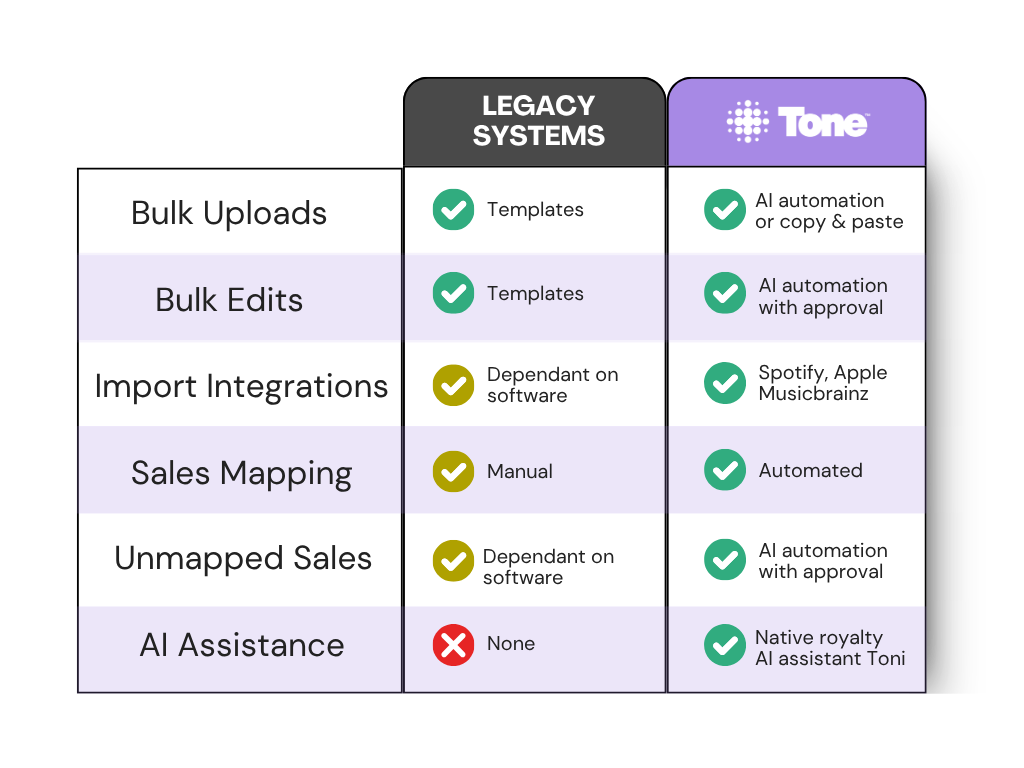
*Competitor comparisons in this post are based on Tone’s internal benchmarking by our team against systems including Curve, SR1, Infinite Catalog and Vistex
Why Royalty Catalog Management Breaks in Legacy Systems
In legacy royalty management systems, before sales are mapped or statements generated, every period starts with reviewing catalog metadata, reformatting data to fit import templates, and uploading files—only for template errors to send you back to Excel to troubleshoot and try again, hoping the next upload succeeds.
Even successful imports don’t guarantee accuracy. Some systems have limited validation checks, allowing issues like duplicate ISRCs to go undetected. Ultimately, the accuracy of your catalog metadata can depend on the royalty system you’re using.
What Makes Royalty Catalog Management Better on Tone
Six features within Tone help you streamline your royalty catalog management. Together, they serve one goal: fewer catalog errors = less fragmented financials and more accurate payouts.
1. Tune Up checks your catalog every time you log in
Legacy systems help you create and import catalog data. But they don’t proactively flag potential issues outside of any import template restrictions. Tune Up does. Our tool scans your catalog, flags data quality issues, and takes you straight to the problem across sales, costs, catalog or contracts to fix it before you calculate.
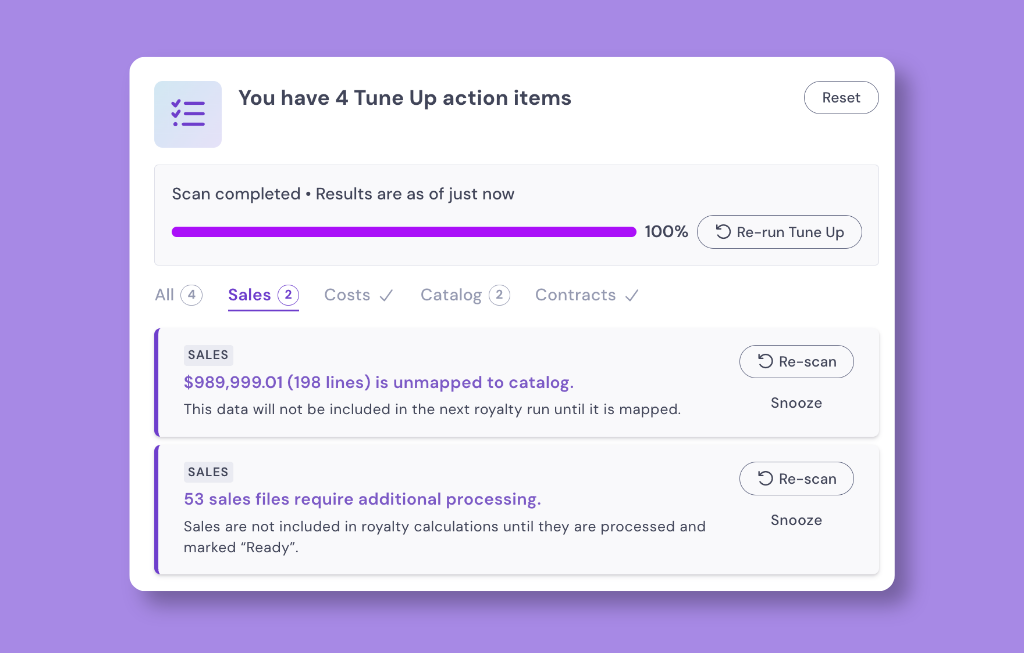
Tune Up flagged 198 sales lines with no matching track or release. That was $989,999 of revenue sitting outside the royalty calculation that would otherwise be excluded from royalty calculations and never make it onto your artists’ statements.
2. Bulk import data without templates
Most legacy systems rely on Excel import templates for bulk uploads and edits. That means transforming that data before you can upload it to your royalty management system. Tone’s Data Importer eliminates that manual work by taking files in their existing format and passing them to Toni, our AI assistant, which proposes any necessary changes. Then, you approve or reject them. Toni never changes anything without your approval.
3. Metadata Fetcher and Enhance Metadata do the research for you
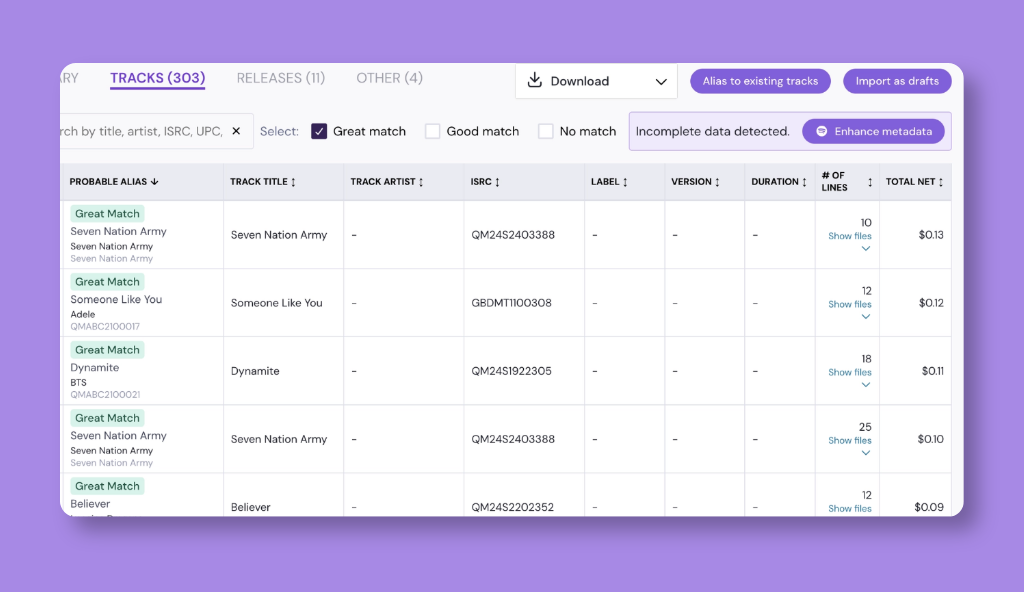
Missing identifiers and inconsistent records usually mean someone ends up manually researching releases one by one. Tone’s Metadata Fetcher pulls missing metadata from Spotify, Apple Music, and MusicBrainz. Enhance Metadata cross-references your records against those sources so you can identify and fix inaccuracies upon import.
Most legacy systems leave that research and leg work to you. Some offer integrations with Spotify or a partnered distributor. But the majority depend on software-specific import templates with limited tools to streamline the process.
4. Unique identifiers stay unique
Tone enforces unique ISRCs and UPCs to mitigate errors. Some legacy systems allow duplicate ISRCs and UPCs without flagging them as errors, risking hidden data quality issues that only surface later as unmapped sales or even worse, potentially as duplicated sales.
In most systems, unmapped sales aren’t treated as a problem. They’re simply accepted as part of the process. At Tone, we understand that unmapped sales can lead to lags in income for your artists. And as a system built to support you in serving your artists – unmapped sales can cause unnecessary financial friction.
5. Unmapped sales come with a diagnosis
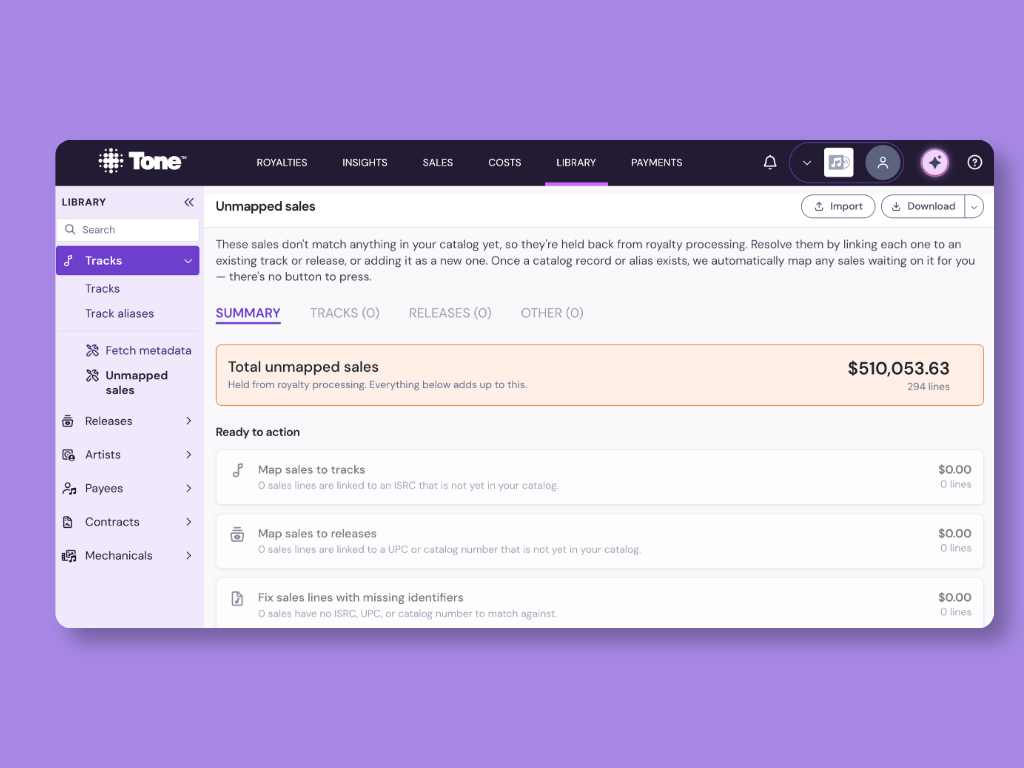
Tone’s unmapped sales tool helps you understand what is causing the disconnect and how to fix it. You get all the information and approve the fixes.
- A detailed summary: unmatched sales sorted by tracks, releases, and missing catalog identifiers
- Intelligent alias match suggestions: identifies unmapped sales reported under alternate identifiers and suggests matching tracks or releases in your existing data, without searching the catalog by hand
- Metadata enhancement: create new catalog entries from your unmapped sales and enrich with metadata from external sources
6. Toni is your assistant along the way
Catalog management involves a steady stream of small questions. Is this a re-release or a duplicate entry? Which remix is this sale associated with? Legacy systems leave you to work it out on your own. Toni, Tone’s AI assistant, works alongside you.
- Asks questions: clarifies the data and confirms next step before it touches anything
- Makes suggestions: explains its logic, checks for duplicate ISRCs, and compares incoming data against your existing records
- Makes edits, with your approval: proposes changes for you to approve or reject, both in the chat and again as a pending draft
Toni doesn’t change anything without your approval. It handles the repetitive entry work, so you spend your time on the calls that need judgment. None of the legacy systems we compared have an AI assistant for catalog work.
Why Catalog Metadata Accuracy Is More Than An Admin Problem
Catalog management is more than an administrative task – even though most systems treat it that way. Accurate metadata is what your record label runs on. It determines whether sales are matched to the right releases and allocated to the right royalty contracts. And that directly impacts your artists’ statements and, ultimately, your entire music business.
Tone’s catalog tools are built to cut the manual cleanup time and catch problems before they reach statements. Ready to streamline your catalog management and have an AI assistant to help you manage your catalog? See what it looks like to make the switch.