
Every royalty period, DSPs send music labels (or rights holders/business managers) statements with millions of rows of streaming and sales data. Each line is tied to ISRCs or other identifiers that your royalty system matches against your catalog.
The ones that don’t match become unmapped sales. Also known as the revenue your music label received — for streams your artists generated — that your royalty system can’t connect to a catalog record. Without a match, those sales don’t flow into a royalty calculation. They don’t appear on a statement. And for your artists, that money hangs in limbo and their period financials don’t correlate to their streams.
Royalty payout inaccuracies often trace back to catalog metadata. Not platform errors, complex deal terms or reporting differences. Metadata gaps in the label’s own catalog — missing ISRCs, name variations, unlogged releases — leave DSP sales lines with nowhere to land.
This guide covers what unmapped sales are, why they happen, and what clean catalog metadata management actually looks like for modern record labels.
What is music catalog data management?
Catalog data management is the process of keeping release, track, and rights metadata — ISRCs, UPCs, artist names, contributor credits, splits — accurate and consistent so that every sale or stream can be matched to the right recording and rightsholder.
In royalty accounting, accurate catalog data is the foundation of reliable reporting. Even the most sophisticated royalty system can produce incorrect statements if the underlying data is incomplete or inaccurate. Ultimately, royalty calculations are only as accurate as the data they’re based on.
What tools are available for music catalog data management?
Spreadsheets and DIY systems
Most independent labels start here: a master spreadsheet of releases, track lists, ISRCs, release dates, and royalty splits, maintained by whoever handles royalty accounting. It’s flexible and free, and it works at small scale.
But anyone who’s managed royalties in spreadsheets knows the challenges that come with it. Artist names and track titles aren’t always consistent. Duplicate tracks can accumulate when the same ISRC appears across multiple releases. As your catalog grows and new distributor reports come in, keeping everything organized and accurately matching sales becomes an increasingly time-consuming, manual process.
The industry argument against this approach is that streaming-era data volumes have outgrown what spreadsheet-based management can handle reliably. A single DSP statement can contain hundreds of thousands, or even millions, of sales rows. Manually reconciling that against a spreadsheet doesn’t scale.
Royalty accounting platforms
Dedicated royalty platforms keep catalog data inside the same system used to process royalties — so when a DSP statement comes in, sales lines are matched against structured catalog records rather than a spreadsheet lookup. The catalog management layer is built to support the royalty calculation: ISRCs, track duration, UPCs, distribution channels, and more live in the same place as contracts and sales data.
This is where labels typically land once their catalog size or roster complexity outgrows spreadsheet-based management. The tradeoff is setup investment — getting catalog into a royalty platform accurately takes real work upfront, and the quality of that data determines how much ongoing cleanup and reconciliation is required.
Distributor-provided dashboards
Many distributors store basic catalog metadata alongside their analytics and payment tools. These cover the revenue flowing through that specific distributor, but labels with multiple income sources — different distributors for different territories, direct DSP deals, sync income, licensing — still need somewhere to consolidate the full picture. Your DistroKid dashboard can answer, “How are my DistroKid releases performing?” It can’t answer, “Who is my highest-performing artist this month (across all revenue sources)?”

Why does music metadata get messy?
ISRC mismatches and duplicates
ISRCs are designed to be unique identifiers — one code per recording. In practice, inconsistencies can develop as catalogs grow. The same recording may be assigned different ISRCs across distributors or re-releases. Tracks appearing on compilations may also be reported under identifiers that don’t exist in the label’s catalog. Sales come in against those codes, find no match, and sit.
The issue isn’t with ISRCs themselves, but with maintaining consistent identifiers across a growing catalog and multiple distribution partners. Without regular catalog maintenance and reconciliation, these discrepancies can lead to unmatched sales and incomplete royalty reporting.
Unmapped tracks from new DSPs and revenue sources
Each new revenue source brings its own statement format, its own identifiers, and its own edge cases. Until that DSP’s identifiers are verified against your catalog, the first few periods from that source are likely to generate unmapped sales. And as you continue releasing new music, unmapped sales can appear each month, making catalog maintenance an ongoing process.
This is a solvable problem. It requires someone to work through the new source’s statement, identify the unmapped items, create new catalog records or add alternate identifiers to existing ones, and verify that the match is correct before it’s applied.
Catalog acquisitions and legacy data
Acquired catalogs arrive with whatever documentation the previous owner maintained. That might be a well-organized spreadsheet with verified ISRCs. It might be data exported from a different royalty platform, structured around that platform’s data model rather than yours. It might be a Google Sheet with a list of track titles and Spotify URLs. And if an acquired catalog is distributed across multiple partners and reporting sources are being transitioned, verifying that identifiers are correctly matched across all sources can be a time-consuming process.
Manual entry at scale
Catalog data is entered by people, and people make errors at scale. A transposed digit in an ISRC. A misspelled artist name. An incorrect track duration. Individual errors may seem small, but their impact can be significant. A transposed digit in an ISRC can cause sales to be matched to the wrong track and royalties allocated to the wrong payees. A misspelled artist name can result in a track being overlooked when linking recordings to an artist’s contract, leaving royalties unreported. An incorrect track duration can affect the statutory mechanical royalty rate applied.
Across thousands of tracks and dozens of periods, these errors accumulate — and because metadata issues often don’t surface until a statement is being reviewed, they’re frequently caught after royalties have been processed.
How do unmapped sales impact royalty accounting?
An unmapped sale is a revenue line in a distributor statement that can’t be matched to a known track or release in the label’s catalog. The DSP paid for those streams. The label received that payment. But without a catalog record that matches the identifier on that sales line, the royalty system has no way to know which artist it belongs to, which contract it should flow through, or how to calculate what’s owed.
That sales line sits unprocessed. It doesn’t appear on any artist’s statement. It doesn’t flow into the period calculation. For the artist whose streams generated that revenue, the period looks incomplete — because it is. The sales from those streams remain unmapped and unreported until someone identifies the problem, creates an alias or updates the catalog record, and runs the next royalty calculation.
The real cost of unmapped sales
Money
Unmapped sales are real revenue attached to real streams that artists generated. When those sales sit unprocessed, that income doesn’t appear on statements and doesn’t reach the artists it belongs to. For labels managing large rosters or high-volume catalogs, the aggregate value of unmapped sales across a period can be significant. Beyond the immediate impact of underreported royalties, there’s audit exposure: if a rights holder challenges a statement and the discrepancy is traced back to incomplete or inaccurate catalog metadata, the label may be held responsible.
Time
The manual work of identifying and resolving unmapped sales falls on the royalty team. For labels without a system that surfaces unmapped items automatically, that means working through distributor statements line by line, cross-referencing identifiers against catalog records, and tracking down which releases generated which codes. Doing this manually can take days per period — time that can’t be spent on higher-value work.
Clarity
A royalty system with significant unmapped sales doesn’t give an accurate picture of catalog performance. Which tracks earn, which territories see growth, what a given artist’s actual streaming revenue was last quarter. These questions become harder to answer accurately when some portion of sales data is sitting unmatched. For labels evaluating catalog acquisitions or negotiating deals, this matters.
Trust
Artists notice when statements don’t align with the performance they’re seeing on streaming platforms. When a track performs well but that activity isn’t reflected in their statements, it damages the relationship. Royalty inaccuracies attributed to metadata issues can often be explained and corrected — but explaining a gap after the fact is different from not having the gap at all.
How record labels manage catalog metadata at scale
The manual approach — spreadsheets, periodic lookups, company-level knowledge about which identifiers match which releases — works up to a point. It breaks when catalog size, roster complexity, or revenue source diversity outgrows what manual reconciliation can handle.
Scalable catalog management looks different. Instead of fixing metadata problems at statement time, the work happens continuously: a single source of truth for catalog records, automated ingestion from DSPs, alias and identifier matching as new sources come in, and a clear workflow for resolving exceptions rather than hunting for them.
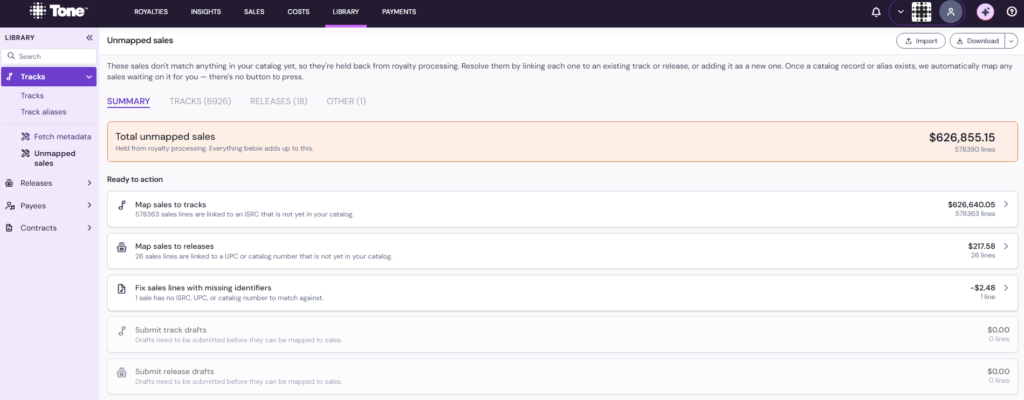
The shift is from reactive to proactive. Labels that spend less time per period on manual reconciliation are usually the ones that invested in keeping catalog data clean throughout the year not just during royalty processing.
"After processing H1 2026 sales and uploading new catalog for one of our services clients, there was still ~5k unmapped lines to resolve. Using the Unmapped Sales tool, I got that down to zero in about 10–15 minutes. Most of the lines resulted from a distributor not reporting product identifiers. The tool made it easy to pinpoint an issue that would have taken me much longer to identify and troubleshoot manually. Tone’s suggested alias matches were also a huge time-saver, especially for a client that frequently releases remixes of the same songs. What could have taken hours of manual cleanup took just minutes.”
Kaitlyn Russell, Manager of Royalty Services
What a modern solution looks like
Tools that address unmapped sales don’t eliminate the underlying complexity of royalty operations. Metadata inconsistencies are an inevitable part of music royalty reporting, but identifying and resolving them manually doesn’t have to be.
At Tone, we build tools to help royalty administrators and music companies streamline this process by automatically surfacing metadata errors that will cause inaccuracies in your statements.
Metadata Fetcher
Tone’s Metadata Fetcher pulls catalog data directly from Spotify so the metadata reflects how the DSP actually lists releases. If a release isn’t found on Spotify, it checks Apple Music, then MusicBrainz. Rather than manually entering release and track records — or risking inconsistencies between DSP metadata and your internal records — the import pulls directly from established music databases. This reduces the gap between what’s in your royalty system and what DSPs report, which is where most unmapped sales originate.
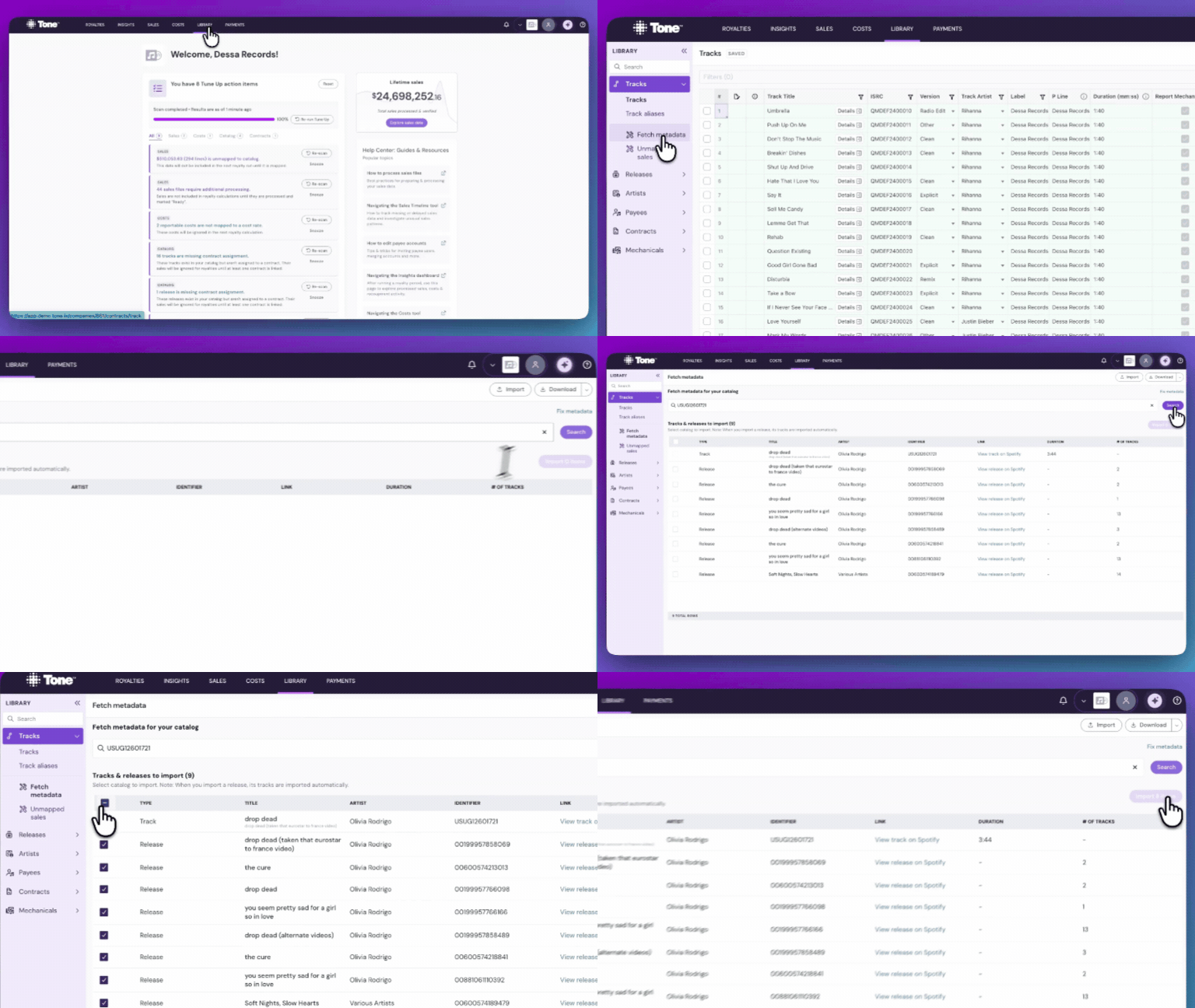
Unmapped Catalog tool
Tone’s Unmapped Catalog tool surfaces every unmatched sales line in one place. Rather than scanning your sales files manually for lines that didn’t match, the tool shows all unmapped items in your catalog — the reported titles and artists, whether these are track-level or release-level sales, and when a catalog identifier (ISRC, UPC, or catalog number) is missing. It also shows which items in your existing catalog might be a match.
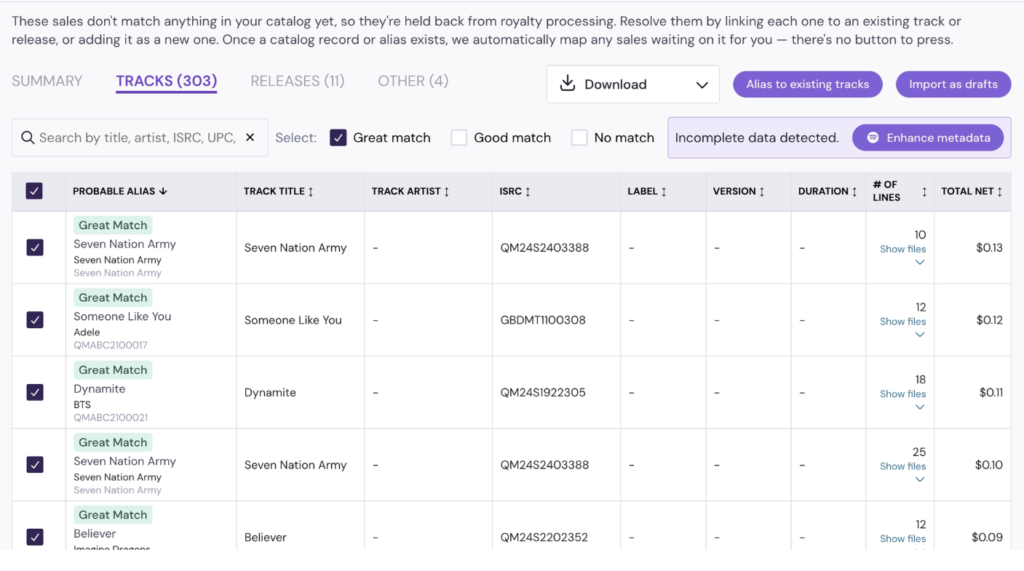
The system shows potential matches scored by confidence level. A “great match” means the title and artist string score above 90% similarity against an existing catalog record. A “good match” is 80–90%. The user reviews the proposed match and creates an alias if it’s correct. From that point on, any sales lines reported using that identifier will be matched to the parent catalog record automatically. The fix is one-time, not per-period.
Of course, not every unmapped sale is an alias waiting to be matched. Sometimes it’s a brand-new track or release that hasn’t been added to your catalog yet. That’s where the “Enhance Metadata” feature comes in. It searches unmapped ISRCs and UPCs across Spotify, Apple Music, and MusicBrainz to help you quickly find and import missing catalog data, without all the manual research and data entry.
Resolving unmapped sales in this workflow becomes a queue to work through, not a needle-in-a-haystack problem. The revenue that was sitting unprocessed gets attached to the right catalog records and accurately reported to the appropriate payees.
How to start cleaning up your catalog metadata
A few steps that apply regardless of which tools you’re using:
- Audit your current unmapped or unprocessed revenue. Size the problem before trying to fix it. How many lines are unmatched? What’s the aggregate value? Which DSPs or releases generate the most unmapped items?
- Standardize artist names and document known aliases. Go through your catalog and identify every known variation — stage name changes, feature credit formats, non-Latin transliterations — and make sure they’re documented in your system.
- Deduplicate and verify ISRCs and UPCs across releases. Identify duplicate or reassigned ISRCs from remasters, re-releases, and distributor changes. Verify that the ISRC in your catalog matches what’s being reported in DSP statements.
- Set up a process for onboarding new DSPs and revenue sources. The first statement from any new source is likely to generate unmapped items. Building an intake process — verifying identifiers against catalog before the first processing period — reduces how many unmapped items you carry into future periods.
- Move from periodic cleanup to continuous matching. Establish a consistent process for adding new tracks and releases as they’re delivered to distributors. Don’t wait until it’s time to process royalties to update your catalog. Maintaining good catalog hygiene year-round, rather than just during royalty processing or audits, it what keeps unmapped sales from piling up.
Frequently asked questions
Conclusion
Why are my music royalties inaccurate? The most common cause of royalty inaccuracies is catalog metadata that doesn’t match what DSPs report. When a DSP sales line carries an ISRC, artist name, or release identifier that doesn’t exactly match a record in your royalty system, that sale goes unmatched. It doesn’t flow into the royalty calculation and doesn’t appear on statements. Most royalty inaccuracies at the label level trace to these metadata gaps rather than to errors at the DSP or PRO level.
What are unmapped sales in royalty accounting? Unmapped sales are revenue lines in a DSP or distributor statement that can’t be matched to a known record in a label’s catalog. The royalty system can’t determine which artist the revenue belongs to or how to calculate what’s owed. Those sales sit unprocessed until the team resolves the metadata gap — either by creating an alias that links the DSP’s identifier to an existing catalog record, or by adding the missing record to the catalog.
What causes ISRC mismatches? ISRC mismatches typically result from remasters or re-releases distributed under a different ISRC than the original, distributor-level ISRC updates not reflected in the label’s catalog records, compilation tracks processed with ISRCs not in the label’s system, or catalog acquisitions where the previous owner’s records used different identifiers. Each creates sales lines that carry an ISRC with no match in the royalty system.
How do record labels track royalties across multiple DSPs? Labels tracking royalties across multiple DSPs need a royalty accounting system that ingests sales files from each source, matches them against a central catalog record, and calculates what’s owed based on the contract terms for each recording. The challenge is that each DSP reports in its own format with its own identifier conventions. The label’s catalog data needs to account for how each platform lists releases. Labels with multiple distributors or DSPs often manage this through a dedicated royalty platform that handles ingestion and matching across sources.
What is music metadata management? Music metadata management is the practice of keeping the information attached to recordings — ISRCs, UPCs, artist names, contributor credits, rights ownership, territory terms — accurate, consistent, and current across the systems that use it. In royalty accounting specifically, catalog metadata is the matching layer between DSP sales data and royalty calculations. When that metadata is accurate, sales lines match, calculations run correctly, and statements reflect what artists actually earned.
How can I find unpaid royalties in my catalog? The most direct way to find unpaid royalties caused by metadata gaps is to audit your unmatched sales — the revenue lines that came in from DSPs but didn’t match any catalog record. A royalty platform with an unmapped sales view surfaces these by value so you can prioritize the items worth resolving first. For each unmapped item, identify which catalog record it should belong to, create the necessary alias or update the catalog record, and confirm the match before applying it. Historical sales for that identifier then flow into the calculation automatically.
Conclusion
Accurate royalties start with accurate catalog data. A royalty system can calculate correctly and still produce inaccurate statements if the catalog underneath it has gaps — because unmapped sales are revenue that never reaches the calculation.
Keeping catalog metadata current is ongoing work, not a one-time setup task. But it’s work that scales with the right tools: a single source of truth for catalog records, a workflow for resolving unmapped items as they appear, and tools that pull accurate metadata directly from the platforms you distribute through.
Tone’s Unmapped Catalog tool and Fetch Metadata tool are built specifically to address this problem at the label level — making unmapped revenue visible and giving teams a workflow for resolving it without manual statement hunting. If you want to see how it works against your specific catalog, book a demo.