
When Dana Shayegan decided to lead Milk & Honey Records, he wasn’t winging it. He joined the management group with 13 years of experience across the industry. From years working at forward-thinking companies like The Collective/Studio 71, iHeartRadio to co-founding the global music-focused label Monk Music, Shayegan has a clear point of view on what a modern record label should look like.
He understands the music business from the inside — the operations, the complexity of royalty structures, and what the legacy royalty systems cost a team in time, flexibility, and growth. He’s worked across independent distributors with their own systems, as well as industry-standard third-party platforms, many of which he characterizes as antiquated and impersonal.

“We tapped Dana to run the label because of his vast knowledge of music and records, but also his deep digital prowess and ability to build voluminous catalogs that earn. Tone is quickly becoming an important part of our little engine that must be organized as we achieve scale. I couldn’t have found someone better to go on this journey with.”
– Lucas Keller, Milk & Honey Founder
Building a Record Label on Modern Music Royalty Operations Software
Milk & Honey Records is the music label division of Milk & Honey Music + Sports + Ventures. Built inside an established management group representing some of the top songwriters, producers and artists in the world, Shayegan and his team come with real experience and perspective on what bad infrastructure decisions cost — and they have no intention of making them. The label runs on a clear set of values: putting songwriters first, making data visible, and staying agile enough to operate the way today’s music businesses actually need to.
For the label, that means operating a non-standard royalty model. It’s a structure built on the belief that creators deserve real ownership. It also requires music royalty operations software that can handle that level of deal complexity without falling back on manual workarounds every period.
Legacy platforms aren’t built for modern music business models. Tone is.
Why Tone: Choosing the Right Music Royalty Operations Platform
Shayegan doesn’t evaluate Tone against a feature list. He measures it against years of working inside platforms that couldn’t keep up. What he finds in Tone is a system built by people who understand the complexity of music and royalty operations — and a real team that treats the relationship as a long-term partnership, not a transaction.
A Royalty Platform That Grows with Your Label
At launch, Milk & Honey Records already has artists signed — generating revenue and accruing expenses — meaning Shayegan needs a platform that can start managing his business and paying out his artists immediately. With a lean team and artist revenue already coming in, manual entry isn’t an option. That’s why Tone’s 5x faster processing speed and automation tools make a key difference.

A Royalty Interface Built for How Labels Actually Work
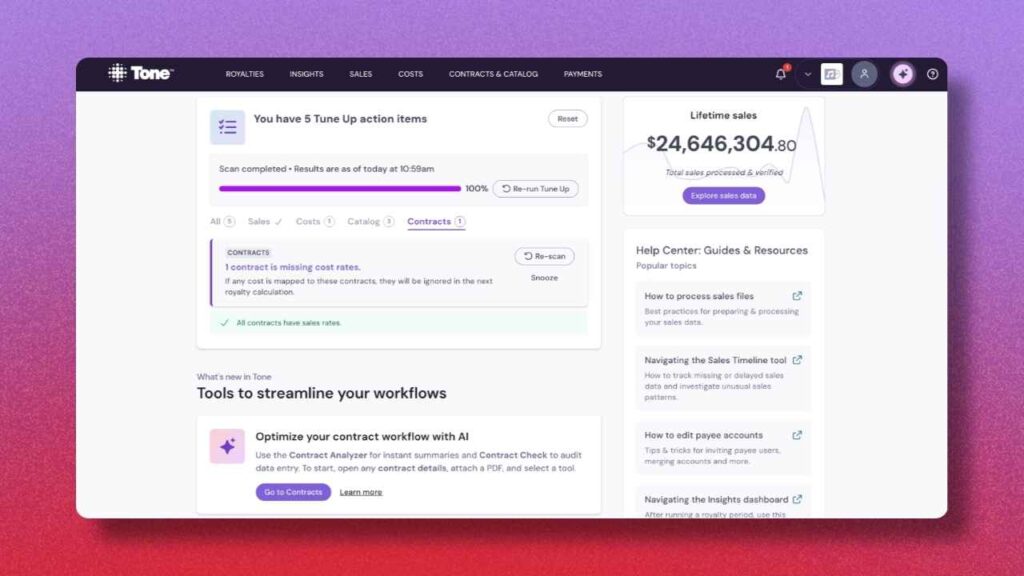
With a modern UI and clear end-to-end workflows, Shayegan doesn’t dread opening the dashboard; he embraces it. For his team, where every hour of administrative friction is an hour not spent on artists and developing the business, usability isn’t just a design preference. It is an operational decision that takes work off Shayegan’s plate.
“The design and aesthetics of the platform just make it easy to use and want to be in every day. It’s modern and intuitive in a way that no other royalty software pays attention to,” Shayegan said.
Tone AI: Building the Future of Royalty Operations
Shayegan believes in AI as an operational lever for modern businesses — not a trend to monitor, but a tool to use now. When he learns about Tone AI, he recognizes a platform actively building toward the future of music royalty operations. His read on the market is clear:
For a label head running lean, that’s a real competitive advantage.
Dashboards That Run the Business, Not Just the Royalties
Royalty management isn’t a back-office function at Milk & Honey. It’s business intelligence. Tone’s dashboards give Shayegan a real-time view of every artist and every revenue line. The ability to share that visibility directly with his team and his artists builds transparency across the business. Everyone sees the same picture. That’s how a modern label has to operate.
Tune Up: The Error-Catching Tool Royalties Always Needed
When Shayegan comes across Tune Up, it changes how he thinks about running royalty periods. Before a period runs, Tune Up surfaces missing or incomplete data across catalog, costs, sales, and contracts — and takes him directly to the issue to resolve it. Legacy systems don’t work this way. Problems surface after the fact, buried in a statement or an artist dispute. Tune Up catches them before the run. That means when Shayegan closes a period, he closes it with confidence. Tone isn’t just where he manages royalties. It’s where he gets an accurate picture of his business.
A Music Royalty Operations Platform with Real Human Support
When something in his workflow surfaces a need, it becomes a real conversation — and sometimes a feature. Tone offers support and a consistent feedback loop between operator and platform. That real human connection matters because it’s exactly what legacy systems don’t offer. For a founder building something new, having a platform that actually picks up the phone isn’t just meaningful — it’s part of the infrastructure.
“It just took a couple days to get our catalog imported. I worked with Scott to build out the template, imported sales files which Tone intuitively created releases for. We double-checked, made some edits and added contracts pretty easily,” Shayegan shared.
What Running on Music Royalty Operations Software Built for Labels Actually Looks Like
Shayegan opens Tone every day. He’s a label head who makes his royalty platform part of how he runs his business. Expenses, sales, artist performance: he wants visibility as it happens, not after the period closes. For him, Tone functions less as a royalty accounting tool and more as a royalty operations portal.
The cross-functional operations of the platform — contracts, catalog management, costs & sales ingestion, payment processing, and insights — make Tone a business tool he actually wants to be in. And he is. Shayegan manages and uploads deal terms in real time and uses Tone to pressure test deal terms, forecast revenue and make business decisions. Then before a royalty run, he uses Tune Up to surface exactly what he needs to clean up before he closes a period. And when statements go out, his team already knows what to expect — because they’ve been looking at the same data all along.
What This Means for Music Labels Starting Out
Milk & Honey Records launches with a clear philosophy: focus on the songwriters, embrace modern technology, and build for what tomorrow’s music business actually looks like — not yesterday’s.
That philosophy extends all the way down to their music royalty operations software. Shayegan doesn’t inherit a system and learn to live with it. He chooses one deliberately, with a career’s worth of context about what the wrong choice costs.
The label is early in its run. But the foundation is already doing what good infrastructure should — running reliably in the background while the label moves forward. As Milk & Honey Records builds its artist roster and expands its catalog, Tone makes it easier to manage new contracts, oversee revenue, accurately pay out, and grow.
Build Your Label on Tone
Milk & Honey Records builds on a foundation that matches their ambition.
If you’re launching or scaling a modern music business and want music royalty operations software that grows with you — Tone was built for you.
Try a platform your entire team can use — with faster processing and analytics you actually trust. Starting right isn’t just a better experience today. It’s a decision that compounds.